
This diagram seeks to sum up our basic model of home groups
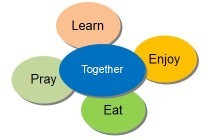
chgrl hone group model
It is drawn from a number of scriptural sources, especially Acts 2:42
They devoted themselves to the apostles’ teaching and to fellowship, to the breaking of bread and to prayer [NIV]
All kinds of groups can be legitimately constituted as home groups if they have these four elements:
- learning about Jesus;
- enjoying (socialising or engaging in some kind of positive joint activity);
- eating;
- praying.
Provided these things are done together.
Here are just a few examples of the kind of group that could be constituted as a home group in this sense.
- bible study group
- cell group
- traditional church home group
- cycling club
- church-based amateur dramatics group
- church maintenance group
- flower arrangers’ group
- community theology group
- church 5-a-side football team
- issue-based study group
- walking group
- book club
- …
We are limited only by our imaginations!
Setting up
A home group can be set up from scratch where there is a felt need. It is important, however, that the need should be there. Churches can, of course, set up traditional home groups, but they need to accept that they will be lucky to get much more than a third of the active congregation into such a group (see “Home groups are not for everyone“.
Churches and other worshipping communities will also have naturally-occurring groups, such as some of the ones listed above. Such groups can be easily reconstituted as home groups by ensuring that the four key elements are present. Often, it is the Learning element that needs to be added and this has to be done with care. If it is done in a heavy-handed way then it could actually damage what is already there. It could even be simply a matter of recognising the learning that goes on naturally already in such a group. For example, the conversations that turn naturally to matters of faith in walking group or a book club.